How to Avoid AI Detection in Writing: A Technical Deep-Dive Guide for 2026
Understanding the AI Detection Landscape
The proliferation of AI writing tools like ChatGPT, Claude, and Gemini has revolutionized content creation across industries. However, this technological advancement has given rise to equally sophisticated AI detection systems that educational institutions, publishers, and search engines now employ to identify machine-generated content. As we navigate through 2026, understanding how these detection mechanisms work—and more importantly, how to create truly human-like content—has become an essential skill for content creators, researchers, and professionals alike.
Edit Your Text to Avoid Detection!
How AI Detection Systems Actually Work
Before diving into avoidance techniques, it’s crucial to understand the underlying technology. AI detection systems don’t measure writing quality—they measure statistical patterns. These sophisticated tools analyze several key parameters:
Statistical Regularity Analysis
Modern AI detectors employ machine learning models trained on vast datasets containing both human-written and AI-generated content. These models learn to identify statistical signatures that distinguish machine output from human prose. According to research from PromptLayer, traditional machine learning methods achieved 96% accuracy when detecting content from smaller language models, but this drops to 74% when dealing with larger models like GPT-2 XL.
N-Gram Pattern Recognition
One of the fundamental detection mechanisms involves analyzing n-gram patterns. AI writing tends to exhibit overly uniform sentence structures, predictable word choices, and consistent paragraph lengths. Machine learning models such as support vector machines or random forests train on these n-gram features to classify text as human or AI-generated. The systems learn from labeled datasets, continuously refining their ability to detect evolving AI patterns.
Perplexity and Burstiness Metrics
AI content typically demonstrates low perplexity (predictability) and uniform burstiness (sentence length variation). Human writing naturally varies in complexity, tone, and structure—qualities that AI systems struggle to authentically replicate without specific prompting or post-processing.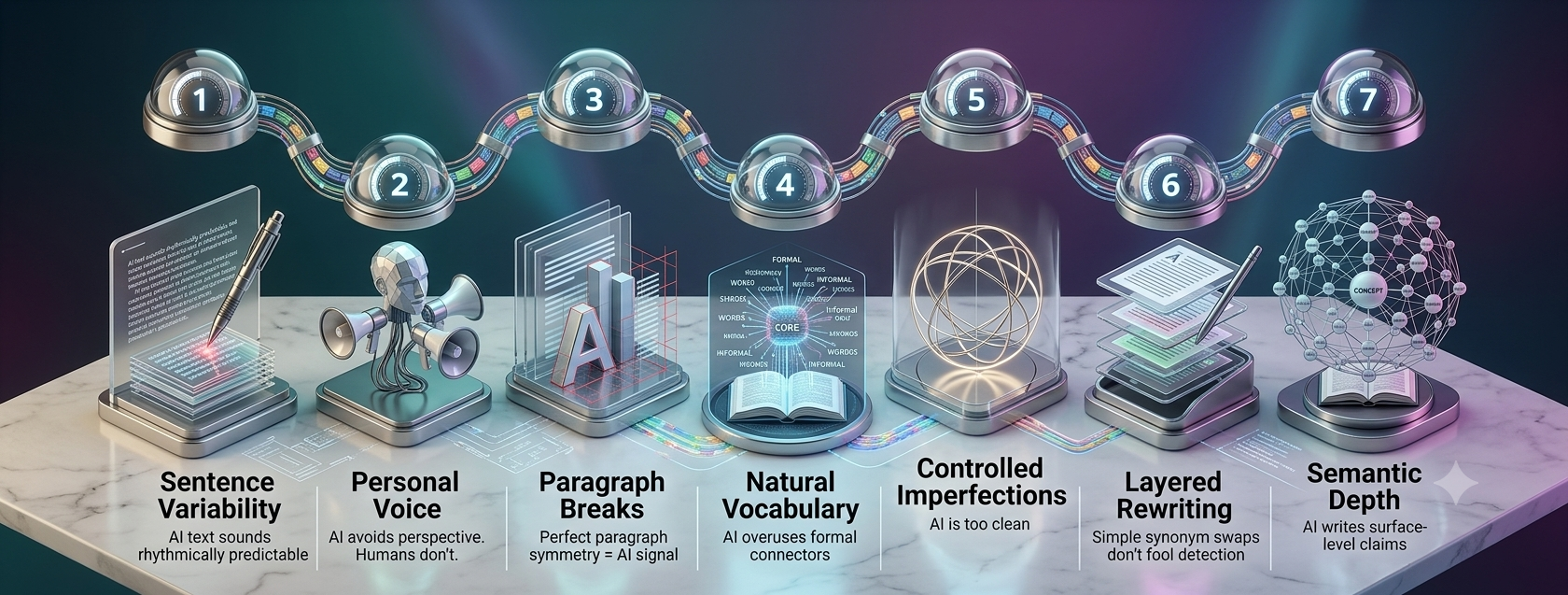
The Seven Technical Methods to Avoid AI Detection
1. Implement Human-Like Sentence Variability
AI detection systems heavily rely on measuring sentence structure predictability. The most effective countermeasure involves introducing deliberate variability into your writing:
Technical Implementation:
- Vary sentence length between 8-25 words for shorter passages and 20-45 words for complex arguments
- Mix simple, compound, and complex sentence structures
- Alternate between active and passive voice strategically
- Introduce occasional sentence fragments for emphasis
- Use rhetorical questions and exclamatory statements sparingly
Research from UndetectedGPT indicates that basic manual editing alone can drop detector accuracy from 39.5% to 22.1%, demonstrating the power of structural modification.
2. Strategic Prompt Engineering
The foundation of undetectable AI content begins at the generation stage. When using AI writing assistants, implement advanced prompting techniques:
Zero-Shot and Few-Shot Prompting:
Craft prompts that explicitly request varied sentence structures, specific tone adjustments, and natural language patterns. Include examples of your desired writing style within the prompt itself.
Chain-of-Thought Prompting:
Guide the AI through reasoning steps that encourage more natural, organic content generation. This approach produces outputs that better mirror human cognitive processes.
3. Employ AI Humanizer Tools
Dedicated AI humanization tools have emerged as powerful allies in creating undetectable content. Platforms like BypassGPT, HIX Bypass, and Undetectable.ai employ sophisticated content restructuring algorithms that:
- Adjust statistical patterns to match human writing baselines
- Rewrite repetitive phrasing with synonyms and structural variations
- Modify perplexity and burstiness metrics
- Remove tell-tale AI signatures while preserving meaning
The most effective approach combines three strategies: manual editing to add personal voice and vary structure, processing through a dedicated AI humanizer to adjust statistical patterns, and testing against multiple detectors before final submission.
4. Content Layering Technique
Rather than generating complete content through AI, employ a layered approach:
Stage 1: Idea Generation
Use AI for brainstorming and outlining purposes only.
Stage 2: Section-by-Section Generation
Generate content in small segments (2-3 paragraphs maximum), modifying each section manually before assembly.
Stage 3: Personal Voice Integration
Add personal anecdotes, professional experiences, or domain-specific insights that AI cannot generate authentically.
Stage 4: Structural Refinement
Rearrange sections, adjust transitions, and ensure logical flow mimics natural human argumentation.
5. Advanced Paraphrasing and Restructuring
AI detection tools look for specific linguistic fingerprints. Combat this through:
Syntactic Transformation:
- Convert active constructions to passive and vice versa
- Break long sentences into shorter fragments
- Combine short sentences into compound structures
- Rearrange clause order within sentences
Semantic Diversification: - Replace commonly overused AI terms with synonymous expressions
- Introduce domain-specific terminology naturally
- Vary hedging language and certainty markers
- Adjust formality levels throughout the text
6. Contextual Personalization
Human writing naturally incorporates contextual elements that AI struggles to generate authentically:
- Location-specific references and examples
- Industry-specific terminology and insider perspectives
- Cultural references appropriate to the target audience
- Personal anecdotes or case studies
- Time-sensitive observations and current event connections
7. Multi-Stage Verification Protocol
Before finalizing any content, implement a rigorous testing protocol:
Detection Testing:
Run content through multiple AI detection tools including GPTZero, Turnitin, Originality.ai, and Winston AI. Each detector uses different algorithms, so comprehensive testing increases confidence.
Readability Analysis:
Use tools like Hemingway Editor or Grammarly to analyze readability scores. AI-generated content often clusters around specific readability levels.
Human Review:
Have subject matter experts review content for authenticity and natural flow. Fresh human eyes often identify areas that sound “mechanical.”
Technical Considerations for Academic and Professional Writing
Turnitin and Academic Integrity
For academic contexts, Turnitin’s AI detection capabilities have become increasingly sophisticated. Research indicates that ethical approaches to AI assistance include iterative prompting to refine outputs, blending AI suggestions with original ideas, and employing paraphrasing tools judiciously. The goal should be enhancement, not deception—using these insights responsibly to elevate your writing while maintaining academic integrity.
SEO and Search Engine Detection
Search engines like Google have developed algorithms to identify and potentially penalize AI-generated content. To maintain SEO effectiveness while using AI tools:
- Focus on producing genuinely valuable, original content
- Ensure E-E-A-T (Experience, Expertise, Authoritativeness, Trustworthiness) signals are present
- Use AI for research and drafting assistance rather than complete content generation
- Add substantial human editing and personalization layers
Best Practices for Long-Term Success
The landscape of AI detection continues to evolve rapidly. Staying ahead requires:
- Continuous Learning: Regularly update your knowledge of both AI generation capabilities and detection methodologies
- Tool Familiarity: Maintain proficiency with both AI writing assistants and detection tools
- Ethical Framework: Establish clear guidelines for acceptable AI assistance in your workflow
- Quality Focus: Prioritize producing genuinely valuable content over merely avoiding detection
Conclusion
Avoiding AI detection in writing is fundamentally about understanding both sides of the technological equation. By comprehending how detection systems work—through statistical analysis, n-gram pattern recognition, and perplexity measurement—content creators can strategically develop content that genuinely mimics human writing patterns.
The seven methods outlined in this technical guide represent a comprehensive approach to creating undetectable AI-assisted content. However, the most effective strategy remains the integration of AI assistance with authentic human creativity, expertise, and voice. As these technologies continue to evolve, the distinction between human and AI-generated content will blur further, making the skills outlined here increasingly valuable for professional content creation.
Remember: the goal isn’t merely to bypass detection systems, but to leverage AI tools responsibly while producing content that genuinely serves readers with authentic value and insight.