Can You Submit an Essay with an 84% Turnitin AI Score? (2026 Guide)
A practical guide to lowering Turnitin AI detection while improving real academic writing quality.
Artificial intelligence has completely changed academic writing. Students now regularly brainstorm with ChatGPT, GPT-5, Claude, Gemini, and other AI assistants. At the same time, universities have upgraded their AI detection systems. In 2026, Turnitin’s AI Writing Indicator has become significantly better at recognizing typical large language model (LLM) writing patterns than it was only a year ago.
One of the most common questions students ask is:
“My paper shows 84% AI. Can I submit it?”
The short answer is probably not without reviewing it carefully.
An AI percentage alone doesn’t automatically prove misconduct, but a very high score deserves a careful review before submission. More importantly, reducing the number isn’t the real goal—producing authentic, well-developed academic writing is.
This guide explains what has changed in 2026 and the practical editing techniques that produce stronger essays.

Why Turnitin Detects So Much AI in 2026
Unlike early AI detectors that mainly relied on perplexity and burstiness, modern academic detectors evaluate a much broader range of writing characteristics.
They now analyze patterns such as:
- Sentence rhythm consistency
- Paragraph organization
- Predictable transitions
- Repeated vocabulary
- Argument progression
- Citation integration
- Evidence explanation
- Overall writing style consistency
Modern LLMs generate extremely fluent text. Ironically, that smoothness often becomes the signal.
Typical AI writing includes: - Every paragraph having almost identical length
- Nearly every sentence being grammatically perfect
- Generic topic sentences
- Repetitive transition words
- Limited critical thinking
- Few personal analytical choices
Academic writing produced by humans usually contains far more variation.
An 84% AI Score Doesn’t Always Mean Your Essay Is “AI”
Many students misunderstand what the indicator represents.
An AI writing score is not:
- Proof of cheating
- Proof that ChatGPT wrote the paper
- A plagiarism score
- A final academic judgement
Instead, it estimates how closely portions of the writing resemble patterns commonly found in AI-generated text.
Several factors may increase the score: - Heavy use of AI drafting
- Extensive paraphrasing without deeper revision
- Overly polished grammar
- Formulaic academic language
- Minimal original analysis
This is why two students using the same AI prompt can receive very different results after editing.
The 2026 Skills That Actually Help

Many “AI bypass” tricks that circulated in 2024 and 2025 no longer work.
Replacing random words with synonyms or adding grammar mistakes usually makes writing worse rather than more authentic.
Instead, successful revision focuses on improving the essay itself.
1. Rewrite Topic Sentences
AI introductions often begin with broad statements.
Instead of writing:
Social media has become an important part of modern society.
Try something more focused:
This essay argues that TikTok’s recommendation algorithm significantly influences political information exposure among university students.
Specific writing naturally sounds more academic.
2. Expand Your Analysis
One of the biggest AI signals is shallow explanation.
Many AI paragraphs follow this pattern:
Evidence → Next Evidence
Instead, use:
Topic Sentence
↓
Evidence
↓
Analysis
↓
Why It Matters
↓
Link Back to Thesis
Adding genuine reasoning improves both writing quality and originality.
3. Vary Sentence Length
Human writing naturally alternates between:
- Short emphasis
- Medium explanations
- Longer analytical sentences
AI often produces similar sentence lengths throughout an essay.
Breaking this rhythm creates more natural flow.
4. Use Real Academic Voice
Instead of relying on generic phrases like:
- It is important to note…
- Furthermore…
- In conclusion…
Use discipline-specific language that reflects the actual argument.
For example:The findings suggest…
This evidence indicates…
A more convincing explanation is…
Academic precision matters more than fancy vocabulary.
5. Explain Sources Instead of Stacking Quotes
Many AI essays insert citation after citation with almost no interpretation.
Good academic writing spends more time explaining evidence than collecting it.
Ask yourself:
- Why is this source relevant?
- How does it support my argument?
- Does it challenge another perspective?
- What conclusion should the reader draw?
That analytical layer is difficult for generic AI writing to imitate consistently.
Editing Workflow That Works in 2026
Instead of trying to “beat” detection software, use a revision workflow that strengthens your paper.
- Draft your ideas.
- Check logical flow.
- Rewrite weak introductions.
- Add deeper analysis after every piece of evidence.
- Replace repetitive transitions.
- Read the paper aloud.
- Make final edits for clarity and consistency.
Students often discover that these improvements naturally make the writing more distinctive while also producing lower AI indicators.
Should You Keep Checking Different AI Detectors?
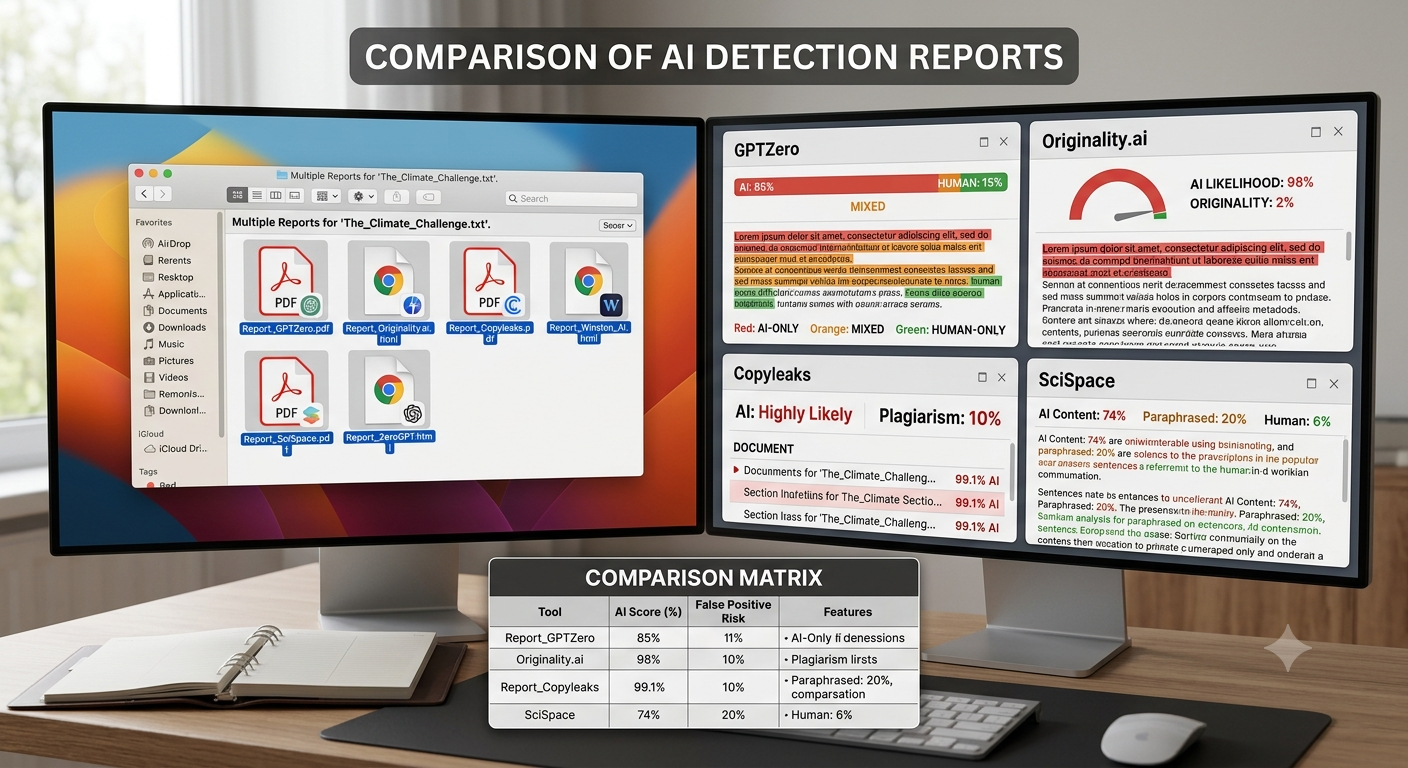
Many students compare results from several tools before submitting.
Each detector uses different models and training data, so percentages can vary considerably.
Rather than chasing a specific number, use detectors as feedback tools.
If multiple systems highlight the same paragraphs, those sections may benefit from stronger explanation, clearer structure, or more original reasoning.
No detector should replace human academic judgement.
Final Thoughts
An 84% Turnitin AI score should not automatically stop you from submitting your work—but it is a strong signal to review the paper carefully.
The most effective strategy in 2026 is not finding a shortcut around detection systems. It is producing writing that reflects genuine understanding, critical thinking, and thoughtful revision.
When your essay clearly demonstrates your own reasoning, stronger evidence, and authentic academic voice, it becomes both a better assignment and a more accurate representation of your work.
Ultimately, the goal isn’t simply achieving a lower AI percentage. It’s submitting an essay that you can confidently stand behind.